

Calculators
None of these calculators will tell you how much you will save, because that cannot be known without measuring. What they do is answer three specific questions with the correct arithmetic, and tell you at what point the answer requires a metering campaign.
Calculator 1
Four numbers from your bill and we tell you what share of your bill pays for power instead of energy, what your effective cost per kilowatt-hour is, how peaky your operation is, and whether the Grid Code (Código de Red) applies to you.
On a GDMTH bill, the capacity and distribution charges are the ones billed on power: they depend on the maximum demand you recorded, not on how much you consumed. They are itemized on the back of the bill or in the billing detail. If your bill groups them differently, send it and we will read it with you.
Calculator 2
This is physics, not estimation. With your active demand and your current power factor, the reactive power to be compensated comes from an exact trigonometric identity. The result is the starting point for sizing, not the sizing.
The kVAr the calculation yields are what is needed at that operating point. Your plant does not operate at a single point: demand and power factor shift with the shift and the process, which is why a bank is sized on the measured distribution, not on an average.
And there is a second, more expensive reason: if your installation has harmonic distortion, a bank sized only with this calculation can resonate with the installation's inductance and amplify the current instead of correcting it. It is the most common cause of capacitors that burn out within a few months. The harmonic spectrum is measured before buying the bank.
Calculator 3
If you know what demand you want to bring it down to and how long your peak lasts, the minimum power and energy of the bank are arithmetic. What is not arithmetic is whether the peak behaves the same every day, and whether the equipment works depends on that.
The system's round-trip efficiency, battery degradation over the years, whether the off-peak charging window is long enough to recharge before the next peak, and whether the peak you measured is the worst of the month or just that day's. Each of those four raises the real size. Take the result as the floor, never as the purchase figure.
What they do not calculate
We tell you this on the same page where we offer you the tools, because the alternative would be letting you believe you already have the answer.
No calculator knows. And it is the data point that decides whether a solar project touches your billable demand or only your consumption. It comes from the measured load curve.
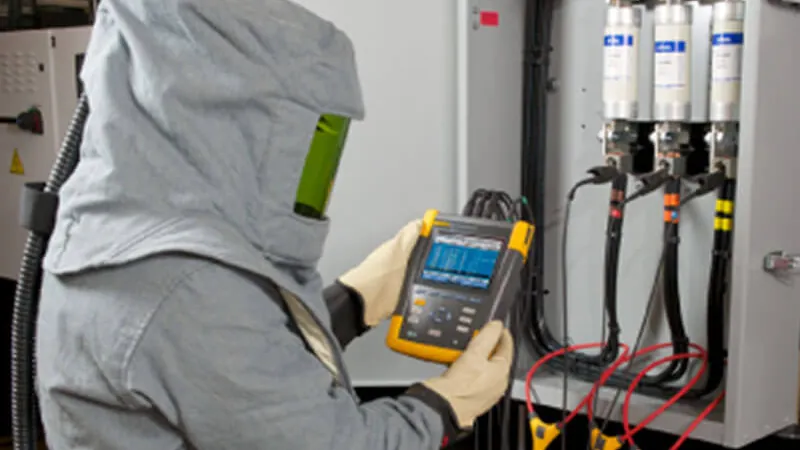
The compensation calculation assumes it is reactive. If it is distortion, the bank does not solve it and can make it worse. A Class A analyzer tells them apart, not a formula.
The calculator tells you whether it applies to you, which is different from whether you comply. Compliance is assessed on short-interval measurements using a percentile criterion, and your bill only shows the average for the period.
All three are answered with a seven-day campaign. And before that, in an initial review with your bill on screen, we tell you what is worth measuring.
How we work
Seven-day campaign with a Class A analyzer.
Engineering based on your real load curve.
Supply and installation inside your fence line.
GTO Vigía sustains the result after construction.

Energy solutions

In a short meeting we review your bill with you, on screen, and tell you what is worth measuring.
We work with plants on medium and high voltage. By sending you accept our privacy notice.
Strengths
GTO Energy offers electrical engineering tailored to your plant. Request your diagnostic and start by knowing where the opportunity is.
Seven days with a Class A analyzer at your facility, before quoting.
Engineering, supply and installation inside your fence line.
Fully creditable if you implement. No finding, no charge.
Compliance reports based on RES/550/2021, filed with the CNE and CENACE.
GTO Vigía: monitoring, monthly reporting and priority service.
We service plants installed by others, starting with a condition survey.