


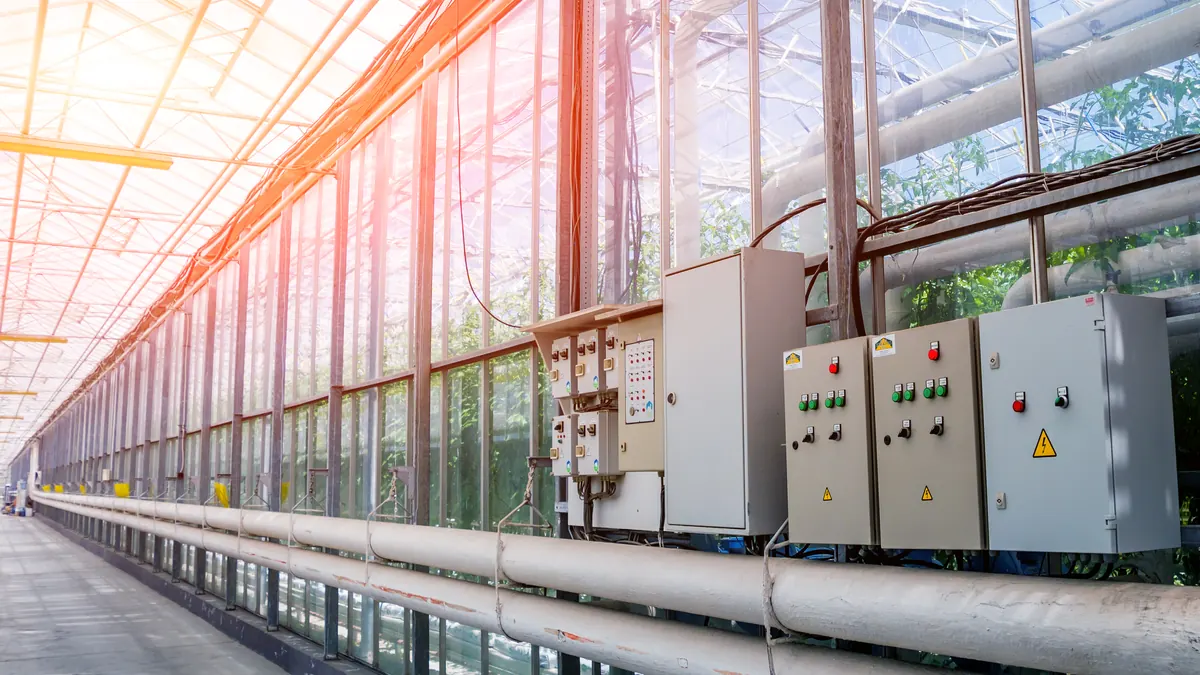
Three outputs from the same fuel
In an industrial plant, cogeneration produces two usable things: electricity and useful heat. In a greenhouse it produces three, because the carbon dioxide in the combustion gases is itself a crop input.
The electricity powers the operation or goes to self-consumption. The heat conditions the greenhouse, which is exactly the continuous thermal demand the technology needs to make a case. And the CO₂, once cooled and conditioned, is injected into the growing environment.
That last point is what sets protected agriculture apart from any other sector: in a factory, CO₂ from combustion is an emission to be managed; in a greenhouse it is a consumable that is probably being bought today.
Why CO₂ enrichment works
Photosynthesis takes carbon dioxide from the air. Inside a closed greenhouse, the crop consumes the available CO₂ faster than it is replaced, and the concentration drops below that of the outside air. From that point on, the factor limiting growth is not light or water: it is carbon.
Raising the CO₂ concentration in the air removes that limit. The effect is on yield and on quality, and it reduces the crop's dependence on outside conditions — which is precisely the reason a greenhouse exists.
That is why many protected-agriculture operations already buy bottled or bulk-supplied CO₂. With on-site cogeneration, that input is no longer bought and starts coming from the same fuel that was already generating electricity and heat.
What to verify before evaluating the project
Actual hours of thermal demand. It is the same filter as in any other sector: without heat to absorb continuously, the engine runs little and does not pay for itself. In greenhouses, thermal demand is seasonal in many regions, so the figure comes from the heating log, not from an assumption.
Whether you buy CO₂ today, and how much. That expense goes fully into the business case and is usually booked under agricultural inputs, not energy, so nobody adds it when evaluating an electrical project.
Gas conditioning. Raw exhaust is not injected: it has to be cooled and treated, and the equipment to do it properly is part of the CAPEX. A project that promises CO₂ enrichment without costing that stage is incomplete.
The regulatory bracket. Below 0.7 MW the plant is an Exempt Generator (Generadora Exenta) and does not require a generation permit. From there up, a permit from the CNE is needed, possibly with a simplified process between 0.7 and 20 MW for self-supply.
A warning about yield figures
Yield increases expressed as percentages and kilograms per square meter circulate on this topic, almost always taken from experiences more than a decade old and from other latitudes, with other varieties, another climate and another incentive scheme.
We do not reproduce them because, applied to a greenhouse in Mexico, they mean nothing. What is general is the mechanism, and that is why it is explained above.
The magnitude in your operation comes from two things you already have: your heating log and your CO₂ bill.
Sources
Electricity Sector Law (Ley del Sector Eléctrico), DOF March 18, 2025 (articles 18, 19, 24, 25, 30 and 42) · Regulations of the Electricity Sector Law, DOF October 3, 2025.
The CO₂ enrichment mechanism is established agronomy. The permit thresholds are the text of the law. This post deliberately contains no yield figure without a verifiable source.
If your greenhouse heats continuously and also buys CO₂, you already meet two of the three conditions. The third is that the hours add up, and that comes from your own log.