


The opening mistake: starting with what is visible
The most common first measure is switching the lighting to LED. It is easy to approve, it is noticeable, and staff see it. It is also one of the measures with the lowest relative impact on an industrial plant's total electricity use.
Meanwhile, the real waste is usually in the steam system, in refrigeration or in motors running at fixed speed. There the orders of magnitude are different, and nobody looks at them because they are not visible.
Hence the one non-negotiable rule: measure before investing. There is an energy version of the 80/20 rule that holds with uncomfortable regularity — a small fraction of the equipment consumes most of the energy. Identifying that fraction first is what makes everything else pay off.
Group 1 · Costs zero or close to zero
Energy culture. Indicators by area, named owners and training. It requires no equipment and its effect is real, although it erodes if not sustained. It comes first because it does not compete with anything for budget.
Correct anomalies that metering reveals. Equipment running on weekends, setpoints nobody has reviewed in years, needlessly simultaneous startups. They show up in the first week of metering and are corrected with an instruction, not a purchase.
Adjust the contracted demand. If your measured demand is consistently below the contracted demand, you are paying for capacity you do not use. It is an administrative procedure and it lowers the bill the following month.
Group 2 · Short payback, simple physics
Compressed air leaks. Compressed air is the most expensive utility per unit of useful energy and one of the worst maintained. There are two numbers worth knowing: a significant share of the air generated is lost to leaks, and every small reduction in distribution pressure lowers compressor consumption proportionally. A leak audit pays for itself with what it finds.
Power factor correction. If your bill carries a surcharge, you are already paying for something that can be corrected. With one condition that is not optional: size on the measured harmonic spectrum. Installing capacitors without measuring harmonics is how resonance happens, and resonance amplifies current instead of correcting it. It is the cause of banks that burn out within a few months.
Thermal insulation. It is the quietest loss there is: an uninsulated run of hot pipe gives off heat twenty-four hours a day, three hundred sixty-five days a year, with no alarm and no symptom. The investment is low and the payback calculation is straightforward arithmetic once the surface temperature is measured.
Group 3 · Engineering, medium payback
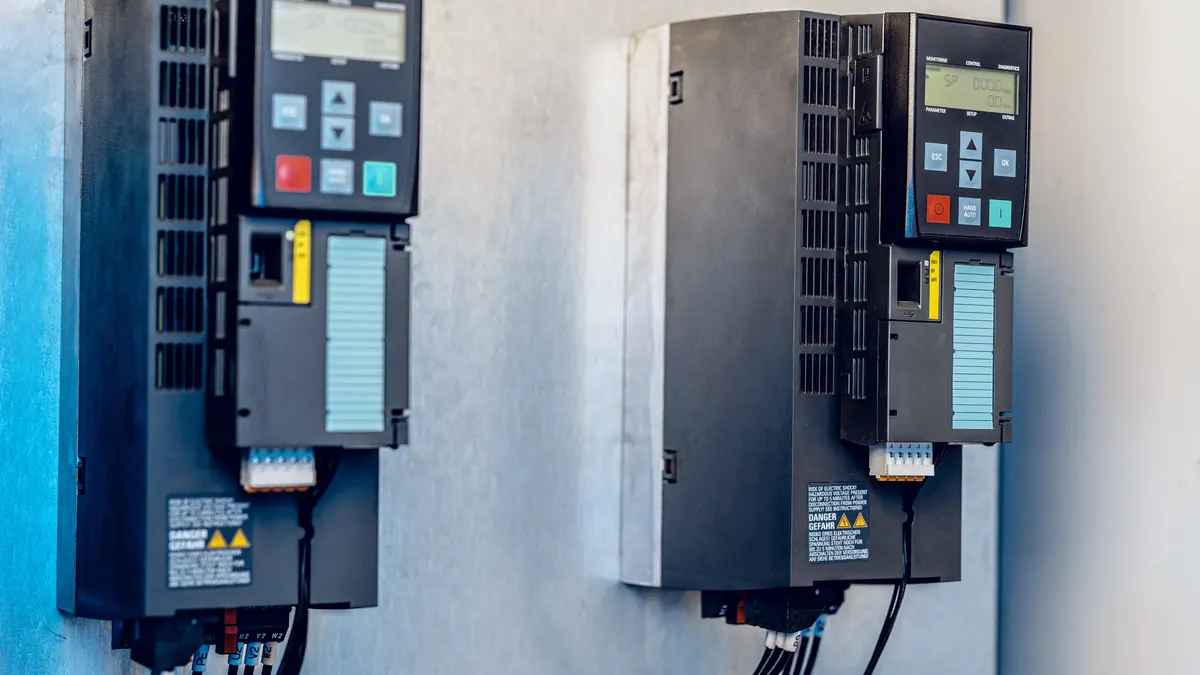
Variable frequency drives. Motors account for most of a plant's electricity consumption, and many run at fixed speed even when the process calls for less. Here is the most favorable relationship on the whole list: the power of a pump or fan varies roughly with the cube of speed, so lowering speed a little reduces consumption much more than proportionally. It applies to variable load; with constant load the drive adds nothing.
Steam system efficiency. Failed steam traps, condensate that is not recovered, blowdowns without automatic control, uninsulated piping. It is where the most energy is lost in plants with boilers and the area that gets the least attention because it does not stop production.
Process heat recovery. Exhaust gases, cooling water, hot product at the end of the line. A well-placed heat exchanger returns that heat to the process — feedwater preheating, drying, space conditioning.
Industrial refrigeration. Low-efficiency chillers, overly conservative setpoints, deteriorated cold-room insulation. In food, beverage and pharmaceuticals it is one of the largest line items. And there is a surprising variant: producing cooling from waste heat through absorption, which practically eliminates the electricity consumption of that refrigeration.
Group 4 · Strategic, they change the cost structure
Real-time monitoring. It does not save on its own: it makes visible what can be corrected and verifies that each measure implemented delivered what it promised. Without it, the savings from the previous groups degrade without anyone noticing.
Peak demand management. Billable demand is set by the peak, even if it lasted only minutes. Controlling load so it does not exceed a threshold, or shaving the peak with storage, tackles a part of the bill that no efficiency measure touches.
Cogeneration. The largest absolute impact, and also the most conditional: it only makes sense with continuous thermal demand. And its permissible size is set by the process's unused heat, not by its electricity consumption.
On the savings ranges that circulate
You may have noticed that this post has no percentages. That is deliberate.
The ranges published on this topic —"save between X and Y percent"— almost always come from the publisher's own projects, and applied to your plant they mean nothing: they depend on your tariff, your hourly profile, your process and the condition of your installation. A percentage stated before measuring is an unfounded promise, and repeating it here would not help you.
The physical mechanisms, however, are general, and that is why they are explained: the pump's cubic relationship, the resonance of a poorly sized bank, the constant loss from uninsulated pipe. That part is verifiable. The magnitude, in your plant, comes from metering.
How to start
With twelve months of bills at hand, in an initial review we tell you which of the four groups holds your opportunity and what we would expect to find when measuring.
If the case calls for measuring, the diagnostic requires no down payment: the fee is fully credited against your investment if you implement with us, and it is not charged if the report does not find a profitable package.
What we will not do is quote you equipment before measuring.
Almost any supplier can hand you these twelve measures. The value is in knowing which of the twelve is yours, and that does not come from a list: it comes from your load curve.